
Breast Cysts
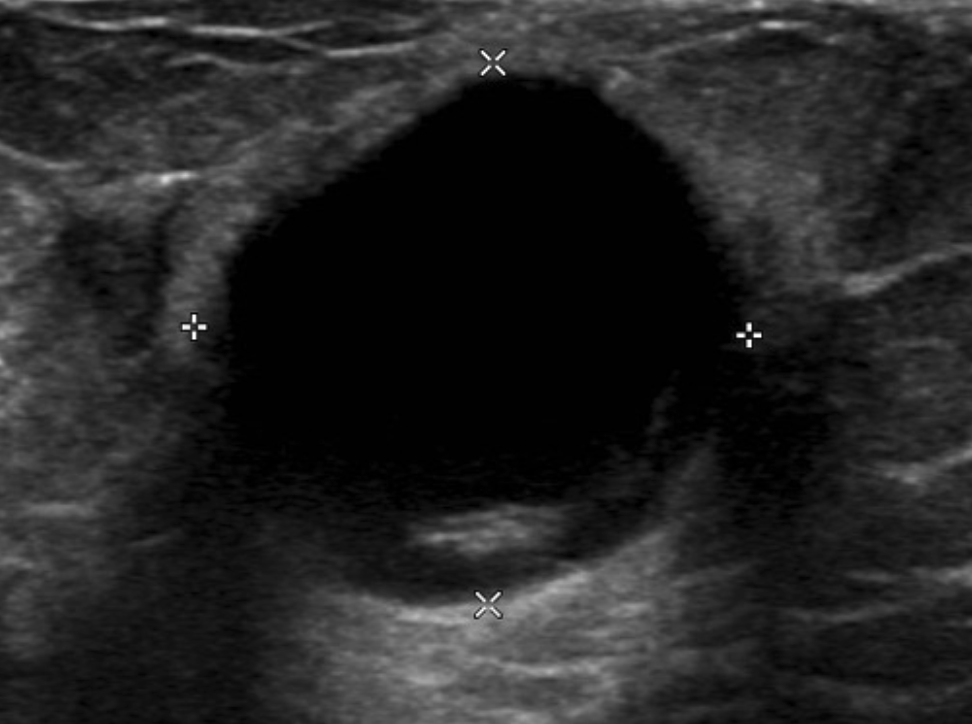
Breast cysts are a common, benign breast condition that are often discovered during breast imaging or after noticing a breast lump. While they can cause concern, simple breast cysts are not cancerous and do not significantly increase the risk of developing breast cancer. This article explains what breast cysts are, how they're diagnosed and when treatment may be recommended.
What Are Breast Cysts?
Cysts in the breast are a common, benign entity that are frequently diagnosed incidentally during breast imaging, although they can sometimes cause symptoms such as a lump.
While the role of imaging and biopsy is to confirm that the lesion is a cyst, it is important to emphasise that cysts are not cancerous and do not significantly increase the risk of developing breast cancer.
Cysts are fluid-filled sacs in the breast that may occur as a single cyst or as multiple cysts. They may come and go and change in size with the menstrual cycle. They form when fluid produced by the duct linings of the breast cannot be adequately absorbed because of a blocked duct, or when the amount of fluid produced exceeds the breast's absorption capacity.
While it is not clear why some women develop cysts and others do not, they are believed to be related to hormonal factors. Breast cysts are very common and are found in up to half of women presenting to a breast clinic. Although they can occur at any age, they are most commonly seen in women between 30 and 50 years of age.
Diagnosis
Often, the diagnosis of a simple cyst can be made from its appearance on a mammogram and/or ultrasound.
On mammogram, cysts appear smooth and round. On ultrasound, they appear smooth, round and black because of the fluid contained within the cyst. These are referred to as simple cysts.
If a cyst does not have these typical features, further investigations, such as a needle biopsy, may be recommended to confirm the diagnosis. Occasionally, a needle biopsy is also performed to relieve symptoms caused by the cyst. In these situations, you may hear the cyst referred to as a complex cyst.
Occasionally, a cyst may become large enough to form a noticeable lump. This lump may be tender, and areas containing several smaller cysts can also become tender. On examination, the lump is usually smooth and round but may feel quite tense due to the fluid under pressure.
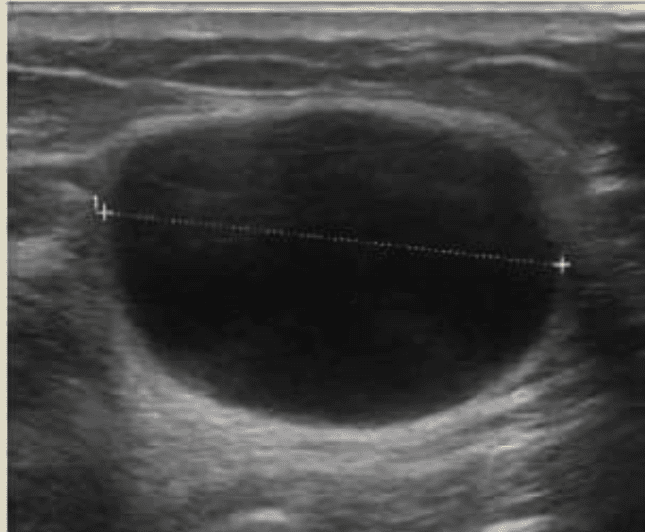
The appearance of a simple cyst.
Treatment
Most cysts require no treatment and, provided they have the typical appearance of a simple cyst, require no further follow-up.
When there is uncertainty about the diagnosis, such as when a cyst has a solid appearance, further investigation with cyst drainage may be recommended.
This involves placing a needle into the cyst under ultrasound guidance to drain the fluid. The fluid is often watery but can sometimes appear thicker or more paste-like. The radiologist may send the fluid for further testing, simply to confirm that the lesion is a cyst.
Rather than performing a cyst aspiration, your doctor may recommend a repeat ultrasound after several months, particularly if there are multiple lesions. This approach is known as short interval follow-up.
Surgery is rarely required. It is generally reserved for cysts that recur after drainage or have concerning imaging features that require a more definitive diagnosis through a surgical biopsy.
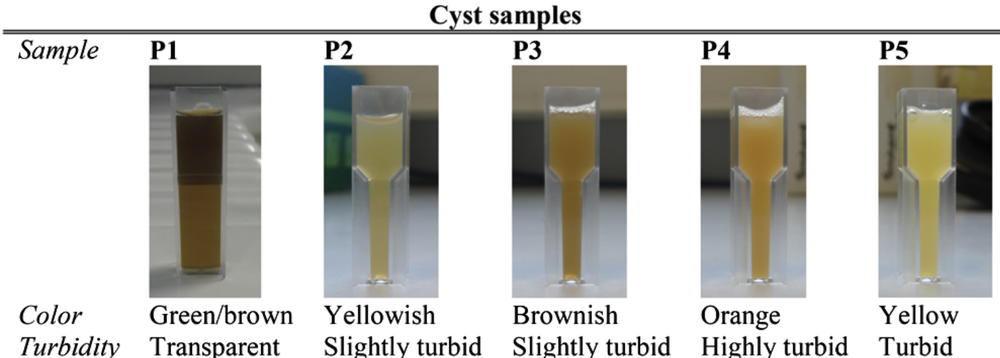
Cyst content: this may vary.
Courtesy of Heijblom M, Piras D, Maartens E, Huisman EJ, van den Engh FM, Klaase JM, Steenbergen W, Manohar S. Appearance of breast cysts in planar geometry photoacoustic mammography using 1064-nm excitation. J Biomed Opt. 2013 Dec;18(12):126009.
Follow-Up
Cysts can recur and may also develop in other parts of the breast.
Once aspirated, they typically take several weeks to refill, if they refill at all.
Are Cysts Cancerous?
Cysts often cause concern because they can produce symptoms, such as a lump, that may also occur with breast cancer. There may also be uncertainty about the diagnosis.
While simple cysts are not cancerous and are safe to leave alone, there is a rare type of cancer known as an intracystic cancer that can develop within a cyst. These lesions usually appear abnormal on imaging and behave differently following aspiration.
Perhaps more importantly, women who have previously had multiple cysts should not assume that every new breast lump is another cyst. Every new breast lump should be investigated appropriately.
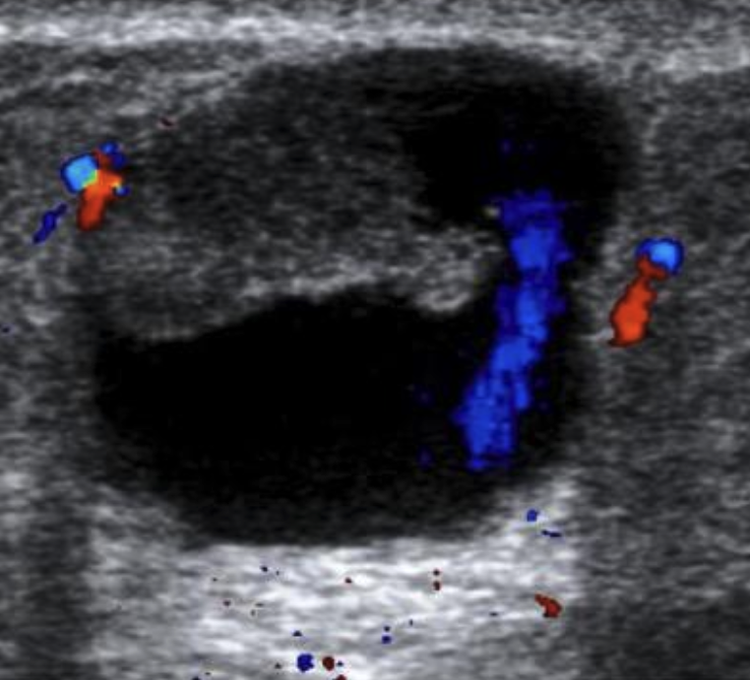
The appearance of a complex cyst.
Need Further Advice?
If you have discovered a new breast lump or have questions about a breast cyst diagnosis, the team at Brisbane Breast and Surgical Care can provide specialist assessment and personalised advice.