
What Is a Hemithyroidectomy and Total Thyroidectomy?
Hemithyroidectomy
This surgical procedure involves the careful removal of a single lobe of the thyroid gland.
This operation is often performed in cases involving solitary nodules or when the diagnosis of a particular nodule remains uncertain.
Typically, the remaining lobe of the thyroid should be able to adequately adjust and continue to produce sufficient levels of thyroxine, thus eliminating the need for any medication following surgery in the majority of cases.
Total Thyroidectomy
This procedure involves the complete removal of your thyroid gland, which is a crucial endocrine organ.
The operation effectively entails performing two hemithyroidectomies to ensure that all thyroid tissues are excised.
Following the surgery, you will need to be placed on thyroid replacement therapy, specifically with a medication called Thyroxine.
It is vital to understand that this therapy MUST be continued for the remainder of your life to maintain proper metabolic function and overall health.
What Is Involved in the Operation?
Procedure Details
Anesthesia: Both operations are performed under general anesthesia.
Hospital Stay: Typically requires an overnight stay; a total thyroidectomy may require two nights if calcium levels are low post-surgery.
Surgical Approach
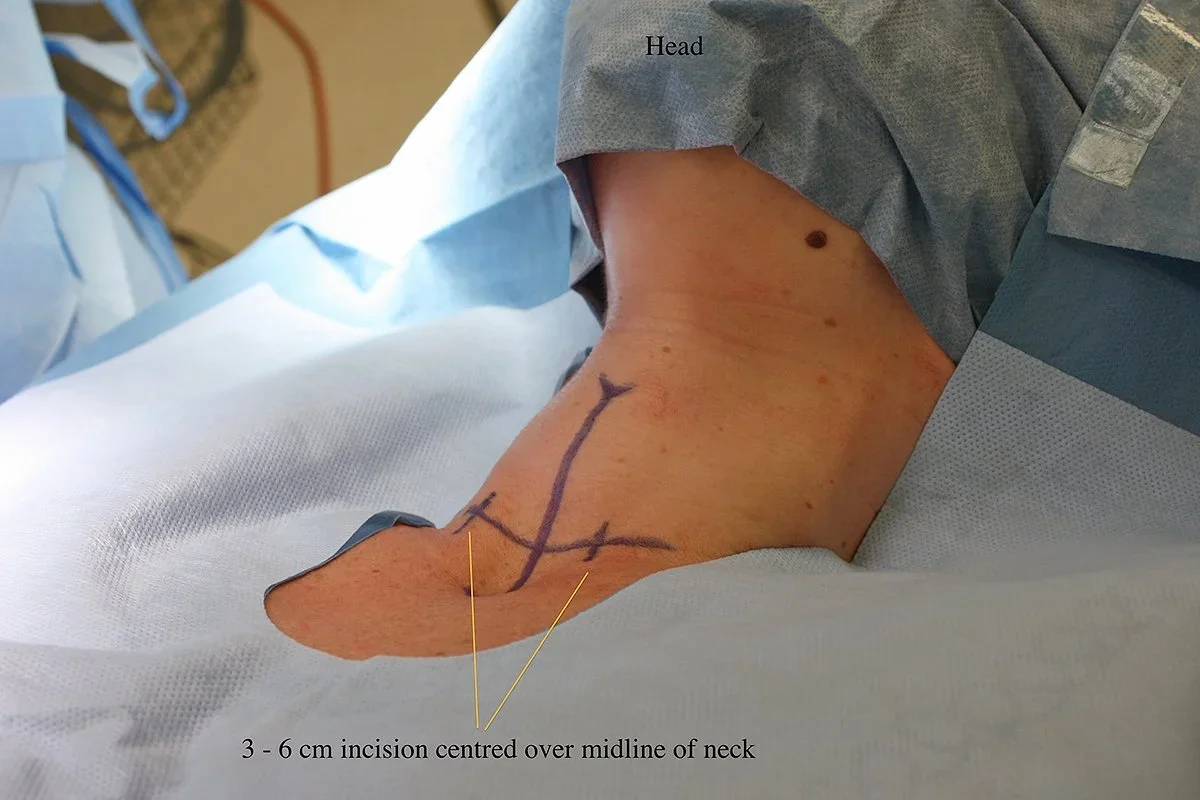
Incision: A small incision (3-6 cm) is made in a skin crease on the front of the neck, larger if necessary for large glands or lymph node removal.
Thyroid Removal: The thyroid is carefully dissected from surrounding structures, with attention to:
Blood Vessels: Multiple small blood vessels must be controlled, along with the major blood supply to the thyroid.
Parathyroid Glands: Small glands attached to the thyroid that regulate calcium levels. Preserving these is crucial; damage carries a 1% risk of requiring lifelong calcium replacement. If damaged, a gland may be reimplanted in the neck muscle and may regain function in about six months.
Nerve Protection
Recurrent Laryngeal Nerve (RLN): Critical for voice and swallowing; damage (less than 1% chance) can lead to a weak voice and swallowing difficulties.
External Branch of the Superior Laryngeal Nerve (EBSLN): Important for voice projection and pitch control, with significant implications for singers and public speakers.
Post-Operative Care
Drain Placement: A drain may be used to manage fluid accumulation.
Stitches and Dressings: Dissolving stitches are used, and dressings can be showered over.
Recovery: Patients can eat and drink immediately after surgery but may experience a painful neck and sore throat, manageable with pain relief.
Monitoring
A blood test will assess the function of the parathyroid glands post-surgery.
Up to 20% of patients may experience temporary loss of function and will be started on calcium tablets as needed.
Do I Need to Take Thyroxine Medication?
Thyroxine is a vital hormone that is produced by your thyroid gland, playing a crucial role in regulating and controlling your overall metabolism.
It is essential to understand that you cannot live without an adequate supply of thyroxine.
Following your surgery, you will be commenced on a thyroxine regimen immediately to help support your body's needs.
While most individuals typically require a standard dose of 100mcg, it is important to note that this dosage may vary depending on factors such as your body size and the results of your pre-operative blood tests.
After your operation, your hormone levels will be closely monitored and adjusted as necessary by Dr. Green, your general practitioner, or endocrinologist.
Initially, you will need to undergo regular blood tests to determine the ideal dosage that works best for you.
Over time, as your levels stabilize, this monitoring may decrease to potentially just annual blood tests, providing a more manageable routine for your ongoing care.
Note: ALL patients having their Total Thyroid removed will need to take Thyroxine tablets permanently.
What Are the Possible Complications?
Thyroid surgery is a common procedure that Dr. Green is well-trained to perform.
Most patients recover normally and leave the hospital feeling good within 1 to 2 days after surgery.
However, some patients may face serious complications.
The information below outlines possible problems from thyroid surgery. "Complications" include both common and rare but important issues.
This list is not exhaustive.
If you have questions after your consultation or this information, please talk to Dr. Green. You can also request an additional appointment to discuss your surgery further by informing Dr. Green or the reception staff.
Common (Up to 10% of Cases)
Temporary nerve palsy (hoarse voice).
Temporary hypoparathyroidism (low calcium that requires tablets for a few weeks - total thyroid).
Stiff neck.
Temporary feeling of pressure in throat for a few weeks.
Uncommon (Less Than 5% of Cases)
Permanent hypoparathyroidism (low calcium that requires tablets for life) – 2% (total thyroid).
Wound infection.
Lumpy scarring (Keloid).
Long term altered swallowing sensation.
Rare but Important (Less Than 1% of Cases)
Anaesthetic complications.
Bleeding requiring second operation to control.
Permanent nerve palsy (weak hoarse voice).
Need for a tracheostomy (breathing tube into trachea through skin to help breathe).
Need Further Advice?
This summary provides a concise understanding of what to expect before, during, and after thyroid surgery.
For any questions, please consult Dr Ben Green’s rooms for an appointment.